Most plants speak about variables as if each possesses a single “specification.” In practice, every input and operating parameter arrives as a distribution—in chemistry, particle size, moisture, bulk density, LOI/organics, contaminant morphology, flow, pressure, voltage, flame geometry, and handling behavior.
In a glass plant, the list is long.
Two shipments can both satisfy chemical specification and still behave radically differently in the furnace because they differ in kinetics: how particles wet, dissolve, react, gas, foam, crust, and transport bubbles or inclusions through the early melt. The furnace does not process a mean value. It processes time-sequenced deviations around that mean.
Granulometry Drift — A Practical Illustration
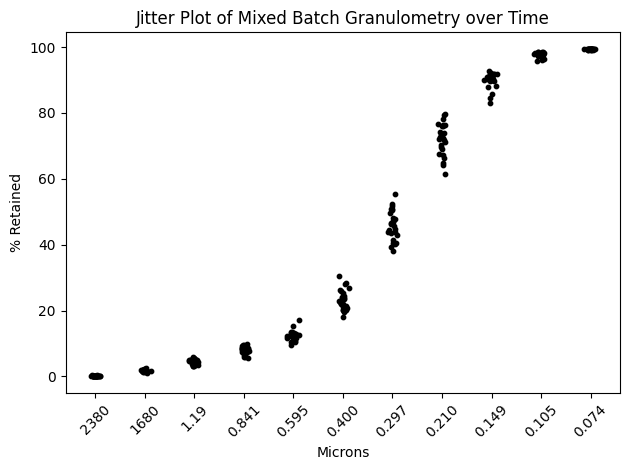
An individual value plot of batch-house granulometry makes this visible. Even when averages appear stable, the spread and temporal drift of particle-size fractions move over weeks and months.
For a float or container furnace, that drift translates into:
- Changes in dissolution time constants
- Shifts in early-melt viscosity
- Variability in gas evolution and sulfate reduction timing
- Altered bubble transport and fining efficiency
- Foam height excursions
- Seed and cord risk downstream
The operational objective, therefore, is not to “hit spec” once. It is to engineer performance so that the fusion sees the narrowest achievable distribution for each of its operating variables under local constraints.
A specification is a scalar.
Plant reality is a spectrum.
Stability is achieved not by compliance, but by attenuating variability anywhere it can be controlled.